FINRA Cybersecurity Checklist: What Financial Firms Are Missing (And How to Fix It)
FINRA has provided a Cybersecurity Checklist to help broker-dealers and financial institutions evaluate their security posture. But in practice, many firms struggle to translate that checklist into actionable steps.
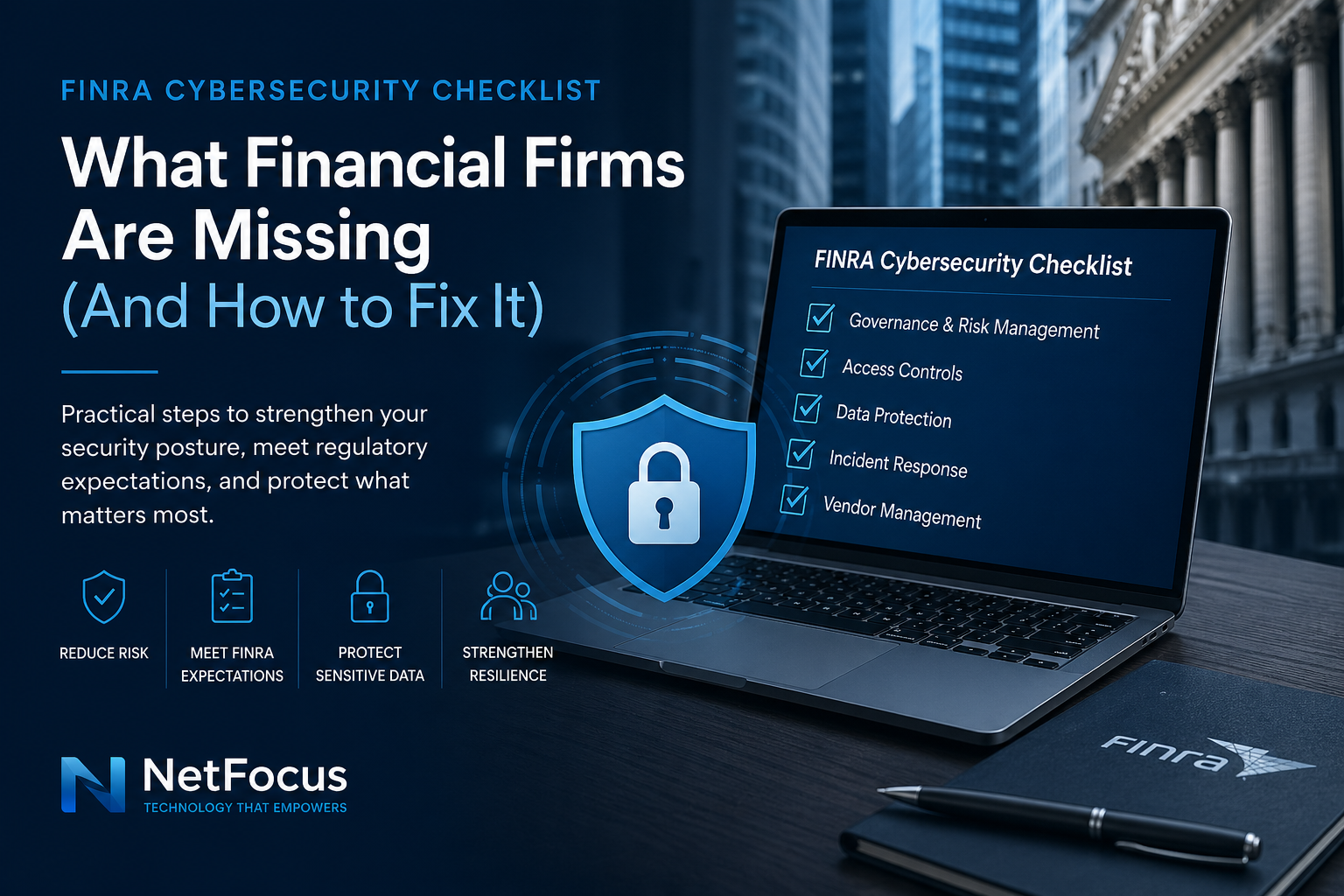
Cybersecurity is no longer just an IT issue — it’s a regulatory, operational, and reputational risk for financial firms.
FINRA has provided a Cybersecurity Checklist to help broker-dealers and financial institutions evaluate their security posture. But in practice, many firms struggle to translate that checklist into actionable steps. For a deeper, control-by-control walkthrough, see our FINRA Cybersecurity Checklist Guide.
Important: Passing a checklist does not mean you are secure. It means you have visibility — what matters is how you respond to the gaps identified.
Why the FINRA Cybersecurity Checklist Matters
The checklist is designed to help firms evaluate risk across key areas:
Governance and Risk Management
Access Controls
Data Protection
Incident Response
Vendor Management
For firms handling sensitive financial data, these are not optional — they align closely with FTC Safeguards Rule requirements and industry best practices like NIST Cybersecurity Framework (CSF).
Where Most Financial Firms Fall Short
1. Governance Without Execution
Many firms have policies in place but lack enforcement, monitoring, or accountability.
Example: A written security policy exists, but no one is actively reviewing logs, alerts, or user behavior.
2. Over-Permissioned Access
Employees often have more access than they need — especially in Microsoft 365 and file-sharing systems.
Risk: If an account is compromised, attackers can access far more data than intended.
3. Weak Vendor Oversight
Third-party tools like CRM platforms, portfolio management systems, and integrations introduce hidden risk.
Reality: Most breaches today originate from compromised vendors or integrations.
4. Lack of Real Incident Response Readiness
Firms may have an incident response plan — but it has never been tested.
Problem: During an actual incident, delays and confusion increase impact and regulatory exposure.
5. No Visibility Into Data Movement
Firms struggle to answer basic questions:
Who downloaded client data?
What files were shared externally?
Was sensitive data exposed?
How to Operationalize the FINRA Checklist
Step 1: Map to a Framework (NIST + FTC Safeguards)
Instead of treating the checklist as a one-time exercise, align it with a continuous framework like NIST CSF.
Step 2: Identify and Prioritize Risk
Not all gaps are equal. Focus on:
Identity and access control weaknesses
Email security and phishing exposure
Data loss and insider risk
Step 3: Implement Technical Controls
This includes:
Conditional Access and MFA hardening
Endpoint Detection and Response (EDR)
Data Loss Prevention (DLP) policies
Backup and recovery validation
Step 4: Test Your Incident Response Plan
Run tabletop exercises and simulate real-world scenarios like:
Business Email Compromise (BEC)
Ransomware attack
Unauthorized data access
Step 5: Continuously Monitor and Report
Security is not a one-time project. Firms need ongoing visibility and reporting to demonstrate compliance and reduce risk over time.
The Hidden Risk: Microsoft 365 and AI Tools
Many FINRA-regulated firms are now adopting tools like Microsoft Copilot and other AI platforms.
⚠️ Caution: These tools do not create new access — but they amplify existing permissions. If your data is overexposed internally, AI will make that risk more visible and easier to exploit.
This makes data governance, labeling, and access control more important than ever.
What a Strong Cybersecurity Program Looks Like
Clear ownership of cybersecurity at the executive level (vCISO or equivalent)
Documented policies aligned with FINRA and FTC Safeguards
Proactive monitoring and alerting
Regular risk assessments and reporting
Tested incident response procedures
Start with a Confidential Risk Assessment
If you want a structured walkthrough of every domain — governance, access, data, incident response, and vendor risk — read our step-by-step FINRA cybersecurity implementation guide.
Understanding where you stand against the FINRA Cybersecurity Checklist is the first step.